
The Answer Is 42: Entering the Question-Driven Economy
As AI makes answers faster and cheaper, the scarce skill becomes defining intent, assembling context, and asking the question that matters.

The answer to the ultimate question of life, the universe, and everything is 42.
There is just one problem: no one knows what the question was.
In Douglas Adams’ The Hitchhiker’s Guide to the Galaxy, the supercomputer Deep Thought spends 7.5 million years calculating the perfect answer, only to reveal that the people asking never properly understood the problem.
That joke has become an unexpectedly accurate metaphor for the AI era.
We have spent the last several years building extraordinarily powerful answer machines. They can write code, analyze contracts, generate strategies, and synthesize vast amounts of information in seconds.
But a flawless answer to a poorly defined question is still the wrong answer.
As AI makes answers faster, cheaper, and increasingly abundant, the scarce resource is shifting. The differentiator is no longer simply what you know. It is your ability to investigate the problem, assemble the right context, identify the constraints, and ask the question that actually matters.
We are moving from an Answer-Driven Economy to a Question-Driven Economy.
The Commodity of Answers
For generations, our educational systems and corporate structures rewarded people for having answers.
The person who memorized the textbook, remembered the syntax, or recalled the historical case study had an advantage. Knowledge was scarce, access was uneven, and retrieving the right answer required time and expertise.
AI has disrupted that model.
Today, many answers are becoming commodities. If you need a Python function to parse JSON, a summary of a 50-page contract, a first draft of a marketing strategy, or an explanation of an unfamiliar concept, a capable model can generate one in seconds.
That does not make knowledge irrelevant. It changes where the value sits.
When answers are abundant, the premium shifts toward deciding:
- Which problem is worth solving?
- What information is relevant?
- Which assumptions should be challenged?
- What constraints must be respected?
- How will we know whether the answer is actually good?
The differentiator is no longer only what you know. It is how effectively you can turn what you know into a precise inquiry.
That is the foundation of a question-driven economy.
Prompting Is Not Syntax Hacking
When large language models first became mainstream, “prompt engineering” was often treated like a collection of magic phrases.
Users experimented with instructions such as “take a deep breath,” “think step by step,” or even “I will tip you $200,” hoping the right incantation would unlock hidden intelligence.
Some techniques improved results. But they also created the wrong mental model.
Effective prompting is not primarily about discovering secret syntax.
It is about structuring the problem.
To ask an AI system a good question, you must first understand the problem space well enough to:
- Break a complex goal into logical parts
- Separate requirements from assumptions
- Define boundaries and constraints
- Identify edge cases and failure conditions
- Establish what a successful outcome looks like
- Provide the information the system cannot infer safely
Prompting is the translation layer between unstructured human intent and structured machine direction.
That is why domain expertise becomes more important, not less.
A professional photographer can produce a better result from a generative image model because they understand composition, lens behavior, lighting ratios, depth of field, visual hierarchy, and film characteristics. Their advantage is not that they know a longer prompt. It is that they know what decisions matter.
The same principle applies to software.
A senior architect can direct a coding agent more effectively than someone who sees only the immediate task. The architect understands systemic design patterns, security implications, operational constraints, data dependencies, and likely points of failure.
When an agent proposes an implementation plan, an inexperienced reviewer may accept it because it appears detailed and technically credible.
An experienced architect may immediately notice that it:
- Overlooks a transaction race condition
- Ignores rate limits on a third-party API
- Creates an unsafe migration path for legacy data
- Violates an existing architectural boundary
- Introduces operational complexity the team cannot support
The value is not merely in generating the plan.
The value is in knowing what questions to ask before the plan becomes code.
Context Is the “Earth” of Modern AI
In Adams’ story, once the characters discover that no one knows the ultimate question, an even larger computer must be built to determine it.
That computer is Earth.
In the modern AI stack, the equivalent is context management.
An AI model does not automatically understand your organization, product, architecture, policies, history, users, or operating environment. It reasons from the information available in the current interaction and whatever supporting systems have been connected to it.
Ask an agent to “build a login page,” and it can produce one.
But it does not inherently know:
- Your authentication architecture
- Your identity provider
- Your design system
- Your accessibility standards
- Your threat model
- Your session-management rules
- Your regulatory obligations
- Your existing code conventions
- Your target user experience
Without that context, the system must guess.
And generative AI is extremely good at making guesses look complete.
This is why context is not a secondary concern. It is part of the question itself.
The right question is not simply:
Build a login page.
It is closer to:
Within this architecture, using these approved components, following these security and accessibility requirements, and preserving these existing integration patterns, propose an implementation that satisfies this user need and can be validated against these acceptance criteria.
The prompt is no longer a clever sentence.
It is a structured representation of the problem.
The most effective AI practitioners are therefore becoming Context Architects. They know how to gather, filter, organize, and deliver the information an AI system needs to reason well.
They understand that more context is not always better. The goal is not to flood the model with everything available. The goal is to provide the right context, at the right level of detail, at the right moment.
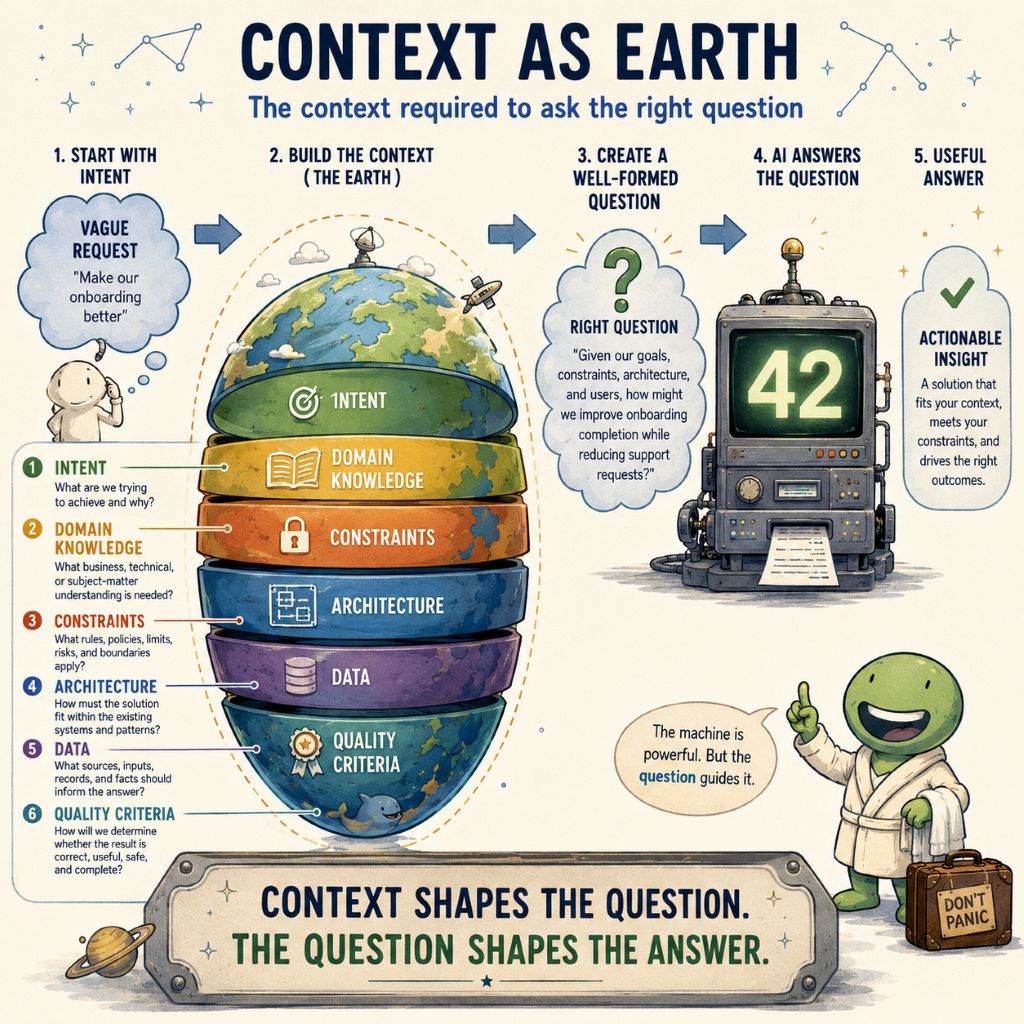
Context as Earth
The “world” surrounding a good AI question is usually composed of several layers:
- Intent: What are we actually trying to achieve?
- Domain Knowledge: What business, technical, or subject-matter understanding is required?
- Constraints: Which rules, policies, limits, risks, and boundaries apply?
- Architecture: How must the answer fit into the surrounding system?
- Data: Which sources, inputs, records, and facts should inform the response?
- Quality Criteria: How will we determine whether the result is correct, useful, safe, and complete?
Together, these layers turn an isolated prompt into a well-defined problem environment.
The machine may produce the answer.
But the human still has to build the Earth around the question.
The Essential Skills of the AI Economy
As more of the execution layer becomes automated, the skills required to create value are shifting.
We are not moving from thinking to automation.
We are moving from doing everything ourselves to directing systems that can do more on our behalf.
That transition elevates four human capabilities.
1. Investigative Curiosity
The first answer is rarely the whole answer.
Strong AI users behave less like requesters and more like investigators. They look beyond surface symptoms, test assumptions, probe ambiguity, and search for root causes.
They ask:
- What problem are we actually observing?
- What evidence supports that interpretation?
- What else could explain it?
- Which assumption is the model making?
- What information would change the recommendation?
Curiosity is what prevents a plausible response from becoming an accepted conclusion too quickly.
2. Context Orchestration
AI systems perform better when they receive a high-fidelity representation of the environment in which the answer must operate.
That requires assembling the relevant requirements, documentation, policies, examples, constraints, and historical decisions.
It also requires judgment.
Not every document belongs in the context window. Not every piece of available data is current, authoritative, or relevant. Context orchestration means deciding what the system needs to know and what would only introduce noise.
3. Critical Taste
When a machine can generate 500 lines of code, 20 design concepts, or a 1,000-word article in seconds, production is no longer the only bottleneck.
Evaluation becomes the bottleneck.
You need the experience and judgment to distinguish between:
- Correct and merely plausible
- Complete and superficially detailed
- Useful and generic
- Elegant and overengineered
- Safe and technically functional
- Good and exceptional
AI can increase the volume of available output. It does not automatically increase the quality of your standards.
Taste remains a human responsibility.
4. Knowing When to Reset
One of the most common failure modes in AI-assisted work is the conversational rabbit hole.
The model misunderstands an early instruction. The user corrects one detail. The model patches the answer but preserves the flawed premise. More corrections follow. Context accumulates, contradictions appear, and both the user and the model begin optimizing a solution that should have been reconsidered entirely.
The instinct is often to keep arguing with the model.
The better move is sometimes to stop.
A skilled AI practitioner recognizes when the conversation has become contaminated by bad assumptions, accumulated patches, or an incorrect framing. They step back, restate the goal, rebuild the context, and begin again from a cleaner angle.
Resetting is not failure.
It is context management.
The Shift for Leaders and Builders
This transition changes the relationship between people and computers.
We are no longer only the typists translating logic into syntax. Increasingly, we are the conductors directing an orchestra of intelligent tools and agents.
For builders, that can be liberating.
AI can absorb much of the repetitive work involved in drafting boilerplate, exploring alternatives, generating tests, summarizing code, documenting decisions, and tracing routine defects.
That creates more room to focus on:
- Product intent
- System architecture
- User experience
- Risk and quality
- Business differentiation
- The core value proposition
But this freedom comes with a higher demand for conceptual clarity.
When execution is cheap, ambiguity becomes expensive.
If you cannot articulate what you want, why you want it, who it is for, what constraints matter, and how success will be judged, the machine will not remain idle.
It will produce something.
It may even produce something polished, internally consistent, and technically impressive.
It will simply be a flawless, hyper-fast answer to the wrong problem.
For leaders, this means AI adoption cannot be reduced to purchasing tools or teaching employees a few prompt templates.
Organizations need operating models that help people:
- Define intent before initiating execution
- Make authoritative context accessible
- Preserve important constraints
- Review outputs with appropriate expertise
- Capture evidence behind important decisions
- Reset workflows when the framing has failed
The organizations that do this well will not merely generate more output.
They will improve the quality of the questions their systems are capable of answering.
We Built the Answer Engines
Douglas Adams’ joke was never really about the number 42.
It was about the absurdity of possessing the perfect answer without understanding the question.
That absurdity now sits at the center of the AI era.
We have built systems capable of generating more answers, more quickly, across more domains than any previous technology.
The next advantage will not come only from making those systems faster.
It will come from becoming better at inquiry.
Better at defining intent.
Better at assembling context.
Better at challenging assumptions.
Better at recognizing quality.
Better at knowing when the original question was wrong.
We have built the ultimate answer engines.
Now, our job is to learn how to ask.
Originally published on LinkedIn. View the original post.