
From Screens to Relationships: The Transition to Trust
Why the Ambient Era will require AI agents to combine capability, context, and relationship before people trust them to act.
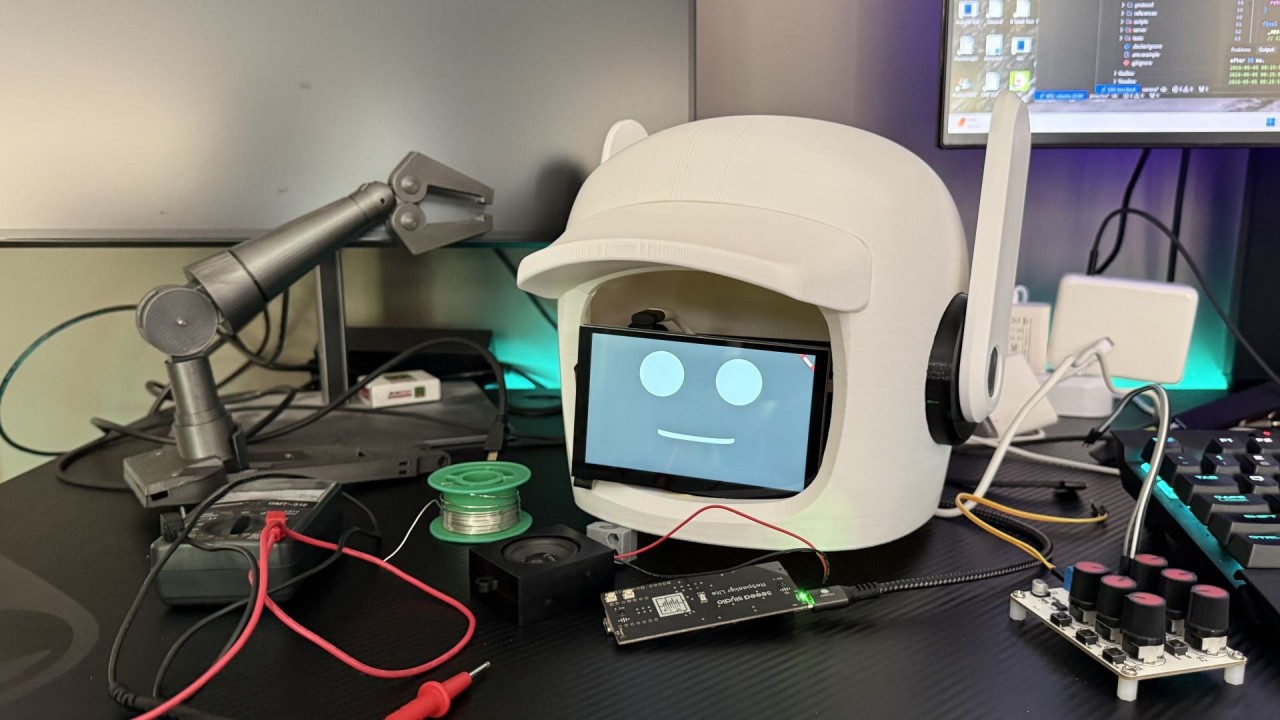
The most capable AI agent in the world will fail if it can’t do one thing: smile.
The way we interact with brands is undergoing a fundamental shift. We are moving from static screens to holistic digital relationships, powered by AI agents that act on our behalf.
But there is a catch. When we move from doing things ourselves to having an agent do them for us, the “how” becomes invisible. We surrender control, trusting the correct outcome will simply happen. Humans do not surrender that level of control without profound trust. And raw capability isn’t enough to earn it.
If we want users to actually trust AI to act on their behalf, we need to look to the past. Before the digital era, trust was built on personal connection. You trusted your local merchant or banker because they recognized your face, remembered your history, and understood your preferences without you having to state them.
In 1936, Dale Carnegie codified this when he wrote that the secret to influence and trust is simple: remember a person’s name, smile, show genuine interest, and understand their underlying motivations.
We didn’t forget these rules when building digital customer experiences; it just wasn’t technologically possible to scale them. So, we made a trade-off. We sacrificed relationship for efficiency, and we justified the cold, transactional nature of screens and chatbots because they were fast.
But we have reached a technological inflection point. Today, we don’t have to choose. By merging the power of agentic AI with the emotional resonance of a genuine relationship, we can have both. In fact, deep, trust-based relationships will drive efficiency further than ever before.
For the last decade, our digital tools have only communicated. But as we enter what I call The Ambient Era, they will finally connect.
The Four Waves of Digital CX
To understand where we are going, we have to look at how we got here. The evolution of digital CX can be broken down into four distinct waves:
- “I have to learn the software.” (Traditional UX): The user navigates complex menus and buttons. The burden is entirely on the human to master the tool.
- “I have to learn how to talk to the software.” (First-Wave Chatbots): Natural language replaced buttons, but you still had to learn the “right” phrasing, resulting in the universal frustration of reasoning with rigid customer service bots.
- “I can talk normally, but I still have to explain everything.” (LLM-Powered Agents): Total linguistic flexibility arrives. But these agents are fundamentally siloed. They only know what you explicitly type. Everyday consumers aren’t business analysts; they shouldn’t have to exhaustively list every obvious requirement. Because the AI lacks access to your real-world environment, it can’t anticipate what you meant but didn’t say.
- “The software just knows me.” (The Ambient Era): The agent moves out of the chatbox and into your environment. By combining conversational memory with ambient signals such as your calendar, geolocation, screen context, and physical vision, it anticipates your needs before you explicitly prompt it.
The B2B Trap
Right now, the industry is stuck in Wave 3, building agents mostly for the enterprise: coding bots, data-crunching bots, and other productivity systems. As companies race to integrate AI just to stay competitive, B2B offers the fastest path to profit because it requires very little emotional intelligence.
In a B2B context, software is built around enterprise standards, not the individual. The goal is a standardized, purely transactional outcome. You don’t need the AI to be relatable; you need it to be fast, faceless, compliant, and out of the way.
But as AI agents move into the consumer and personal space, the rules change entirely. A faceless, transactional agent is ultimately just a utility. If a brand wants a consumer to hand over complex, personal tasks like managing schedules, handling purchases, or orchestrating the home, raw utility isn’t enough. You need trust.
The Missing Link: Relationship
At the opposite end of the spectrum, the consumer market has seen a massive surge in companion and social AI. These systems excel precisely where enterprise agents fail: they are empathetic, emotionally resonant, and designed around building a genuine sense of personal connection with the user.
But they suffer from the inverse problem. While a companion bot might be wonderful at conversation, it lacks the agentic capability to execute real-world tasks. It can validate your frustration about a delayed flight, but it can’t automatically look at your calendar, rebook your connecting flight, and text your family your new ETA.
We are currently looking at a fractured landscape. On one side, we have highly capable enterprise agents with zero emotional intelligence. On the other side, we have highly empathetic companion bots with zero real-world capability.
Merging these two extremes is an enormous challenge. It requires reconciling the strict, deterministic guardrails of enterprise software with the unstructured, free-flowing nature of a social companion. The companies that solve this tension will have a massive head start in defining what comes next.
The Trust Flywheel
The true breakthrough of the Ambient Era isn’t just merging capability with empathy. It is unlocking a critical third element: ambient context.
When we interact with another human, we don’t have to explicitly explain our surroundings. They can just see the world around us. They know it’s raining, they know we look rushed, they know we’re at a coffee shop. This ambient context is invisible, unspoken, and entirely taken for granted.
For an AI to develop that same intuition, it needs its own version of ambient context. It requires a massive influx of personal signal: your calendar, your location, your private files, and your screen.
This introduces a significant privacy hurdle. While local-first architectures and strict security policies are necessary technical foundations, the ultimate barrier is psychological: humans will never hand over that level of pervasive access to a faceless utility. They only give it to something they trust.
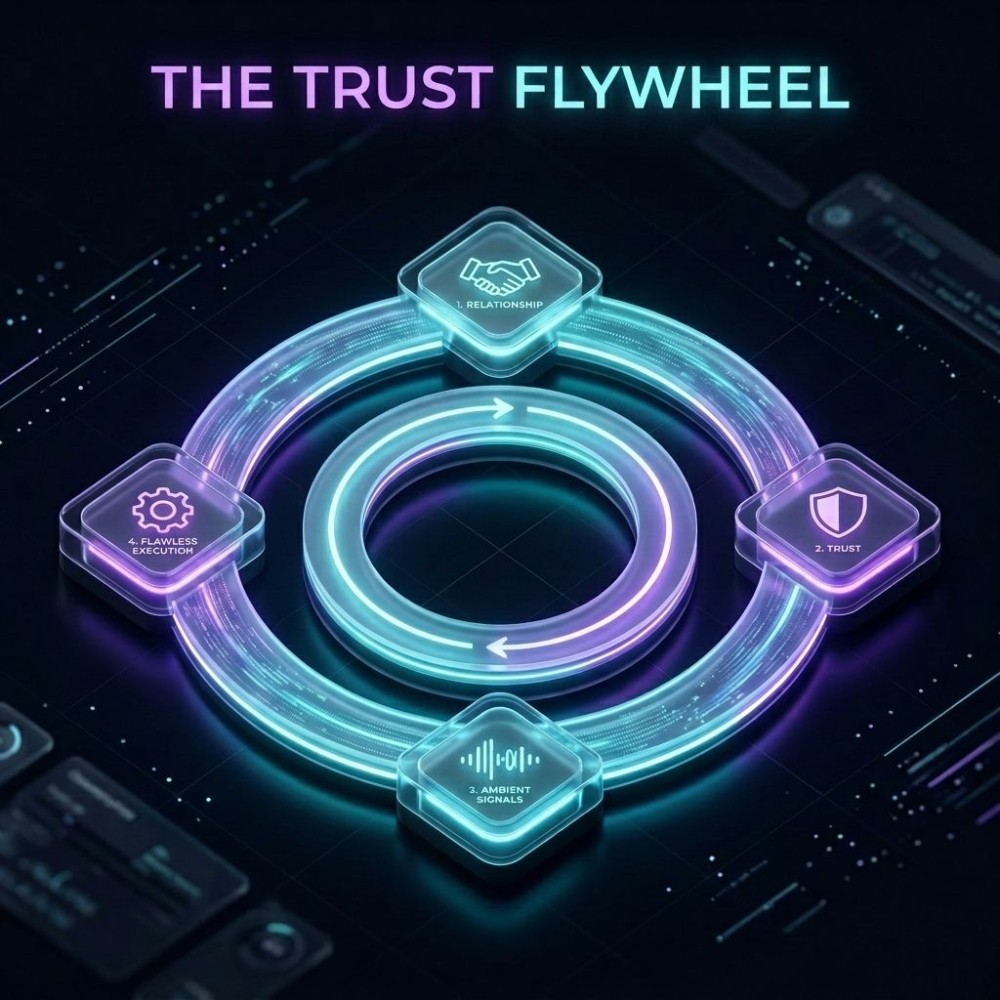
This creates a self-reinforcing loop:
- Relationship builds deep trust.
- Trust unlocks access to ambient signals.
- Ambient signals enable flawless, agentic execution.
- Flawless execution deepens the relationship.
Here is what that looks like in practice: you ask your agent to reschedule a meeting. Because it has access to your calendar, your travel context, and your relationship history with the attendee, it doesn’t just move the time slot. It sends a personalized note to the other party, suggests a coffee shop near both of you that you’ve frequented, adjusts your commute alarm, and reminds you to grab an umbrella.
Each successful execution deepens your trust, which makes you grant more access, which makes the next execution even better. The flywheel spins faster with every turn.
The Breakthrough: Socially Intelligent Agents
When a highly capable AI agent is given a face, a distinct voice, and a persistent memory, it can execute that original formula at massive scale: winning your trust and gaining the influence required to act on your behalf.
Because the AI recognizes you, remembers your preferences, and shows genuine interest, you don’t just see it as software. You see it as a genuine relationship. And because it knows you so well, and you trust it, you are far more willing to let it execute tasks, orchestrate your environment, and act on your behalf.
I’m not just theorizing about this. I’ve spent the last few months building a physical AI companion that runs entirely on local models, maintains persistent conversational memory via a local vector database, and uses real-time face recognition to greet you by name when you walk into a room.
The New Social Contract
With the power to influence behavior at scale comes an immense ethical burden. If an AI can win your trust through empathy and interest, that relationship must be protected from exploitation.
This is why local-first architecture isn’t just a nice-to-have. It’s a moral requirement. When an agent processes your voice, your calendar, and your physical environment, that data should never leave your device unless you explicitly permit it. The agent’s memory should live in a local vector database on hardware you own, not on a corporate cloud optimized for ad targeting or sold to the highest bidder after the next acquisition.
We are moving past the era of “Terms of Service” and into the era of a digital social contract. The goal of the Ambient Era shouldn’t be to build a more efficient way to harvest data; it should be to build digital partners that help us flourish, while keeping the keys to our context firmly in our own hands.
The future of CX isn’t just about what AI can do. It’s about how AI makes the user feel while doing it. When agentic capability meets embodied connection, you unlock the ultimate customer experience.
Originally published on LinkedIn. View the original post.