
Context Outsourcing: The Next AI Lock-In Risk
Why workplace AI creates a new kind of dependency when the most complete map of how a company works lives inside someone else's system.

When Anthropic introduced Claude Tag, the appeal was obvious.
Here was the next step in workplace AI: not a chatbot sitting in a separate tab, but a shared AI teammate living inside Slack. It could be mentioned in channels, follow conversations, draw from connected tools, and build working context from the same stream of discussion your team already uses to make decisions.
For executives, that sounds like the long-awaited easy button for organizational intelligence. Plug it into the conversations, let it absorb the surrounding context, and watch teams move faster.
But the more interesting question is not whether these tools will be useful. They will be.
The harder question is this:
What happens when the most complete map of how your company works lives inside someone else’s system?
Businesses already trust third-party platforms with databases, files, cloud infrastructure, CRM records, source code, and workplace messages. That is not new. Slack already stores the raw communication record for many companies. That trust decision was made years ago.
But workplace agentic AI changes the shape of the transaction.
A message archive is one thing. A continuously updated, machine-readable model of your organization is another.
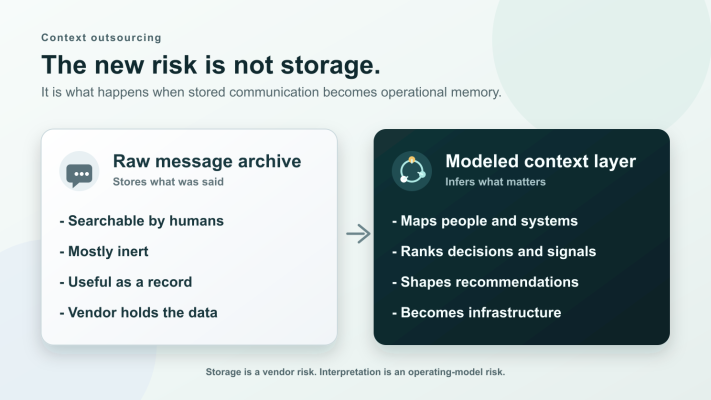
You are not just storing information with a vendor. You are allowing a vendor-controlled system to interpret, compress, rank, and operationalize the context of your business: what matters, who matters, which decisions carry weight, and how the company actually gets work done.
That is a different kind of dependency.
It is context outsourcing.
And if leaders do not treat it deliberately, they may end up building a digital twin of their company that they cannot fully inspect, export, or control.
The Appeal of the Context Easy Button
AI systems are only as useful as the context they can work with.
A foundation model can be brilliant in the abstract and still be useless inside a company if it does not know the product, the customers, the architecture, the current strategy, the political history, or why a decision that looks strange today made sense six months ago.
That is why so much enterprise AI work has focused on context engineering: retrieval pipelines, vector databases, document ingestion, knowledge graphs, permission models, semantic search, and custom agent harnesses.
Workplace agents offer a shortcut. Instead of asking every company to build its own context system, they plug directly into the tools where work already happens. Slack becomes a live feed. Docs, tickets, repos, and conversations become source material. The agent does not need to be briefed from scratch because the surrounding context is already available to it.
That is powerful.
It is also messy.
Raw workplace conversation is not a clean strategic record. It is a blend of brainstorming, urgency, jokes, politics, unresolved disagreement, outdated assumptions, temporary workarounds, and half-decisions that were never meant to become policy.
If a workplace agent treats that stream as the primary source of truth, it can become very fast at amplifying organizational noise.
The risk is not just that the AI may misunderstand a thread. The deeper risk is that companies may let a vendor-owned memory layer become the most durable map of how the business operates.
Your Moat Is Bigger Than Your Files
Most companies understand that their source code, customer lists, product roadmaps, and financial data need protection. Until recently, that was the right mental model: protect the sensitive files and control access to the systems of record.
But context is broader than files.
Context includes the tacit knowledge that gives an organization its operating intelligence:
- Why a controversial architecture trade-off was accepted.
- Which customer complaints are isolated noise and which indicate a market shift.
- Which internal policies are real constraints and which are historical leftovers.
- Who actually knows how a critical system behaves in production.
- Which product bets are strategic priorities and which are experiments.
- Which decisions were made for technical reasons and which were made because of timing, staffing, regulation, or customer pressure.
This is not always written down cleanly. It lives in threads, meetings, tickets, code comments, support escalations, and the memory of people who have been around long enough to know what the documents do not say.
These AI systems are valuable precisely because they can begin to structure this tacit knowledge.
That also makes them strategically sensitive.
When you invite an AI teammate into the center of your operating environment, you are not simply uploading documents. You are helping construct a machine-readable model of your company’s behavior, priorities, constraints, and decision patterns.
That model may become part of your competitive advantage.
So the question becomes: who owns it?
Cognitive Lock-In
Traditional cloud lock-in is painful, but at least the migration object is usually legible. You can move databases. You can export files. You can migrate source repositories. You can rebuild infrastructure elsewhere, even if the work is expensive.
Workplace AI lock-in is harder because the valuable asset is not only the raw data. It is the interpretation layer built on top of it.
If an AI teammate develops a useful working understanding of your codebase, customer history, internal language, team structure, decision process, and operational rhythms, can you take that understanding with you?
Can you export the memory?
Can you inspect the semantic index?
Can you rebuild the same context graph with another model provider?
Can you separate your company’s durable knowledge from the vendor’s proprietary product layer?
In many cases, the answer is unclear.
That uncertainty creates a new form of lock-in: cognitive lock-in.
It shows up in three ways.
- The noise tax. Workplace agents consume messy organizational input. Slack channels are full of duplicated context, stale assumptions, jokes, status chatter, emotional residue, and partial decisions. If the agent has to burn tokens and reasoning cycles to separate signal from noise, you are not only paying for useful work. You are paying to parse your own communication debt.
- Operational fragility. As teams route more work through an workplace agent, the agent becomes part of the operating system of the company. Outages, permission changes, pricing changes, model changes, and product-policy changes can all affect workflows that employees have quietly come to depend on.
- Cognitive drift. If the underlying model or retrieval behavior changes, the agent’s interpretation of your internal context may shift. It may summarize policies differently, weigh old decisions differently, or apply engineering conventions inconsistently. These changes can be subtle enough that teams notice only after quality degrades.
This is not an argument against workplace tooling AI. It is an argument against pretending that the memory layer is disposable.
Once an AI system becomes the place where organizational context is interpreted, it becomes infrastructure.
The Digital Twin You May Not Control
Pair enough corporate context with a capable AI system and you are doing more than automating tasks.
You are creating a kind of digital twin of the business.
Not a perfect copy. Not a sci-fi duplicate. But a functional model that understands enough of the company’s language, constraints, workflows, people, systems, and history to act as an operational proxy.
Inside the company, that could be incredibly useful.
It could help onboard employees faster. It could surface dependencies leaders did not know existed. It could explain why a product decision was made. It could identify repeated customer pain. It could help teams simulate the consequences of a process change before rolling it out.
That is the upside.
The governance question is whether the organization can inspect, constrain, export, and replace the system that holds that model.
If the answer is no, then the company has not simply adopted an AI tool. It has allowed a vendor-owned abstraction of the business to become operationally important.
That should change how executives think about procurement, security, architecture, and data strategy.
The concern is not only “will this vendor leak my data?”
The concern is also:
- Can we tell what the system believes about us?
- Can we correct that belief when it is wrong?
- Can we preserve useful context if we switch providers?
- Can we govern which conversations become durable memory?
- Can we distinguish official business intent from informal chatter?
- Can we audit how context influenced an important recommendation?
These are not edge cases. They are the basic questions of enterprise control in an AI-native workplace.
What Portable Context Should Mean
Rejecting workplace tooling AI outright is not realistic. Companies are under pressure to move faster, and these tools will deliver real productivity gains.
The better response is to demand portability and build for it from the start.
In the next phase of enterprise AI, leaders should treat context portability as a first-class requirement. Not as a nice-to-have. Not as a future roadmap promise. As part of the architecture.
At minimum, portable context should include:
- Source-grounded memory: The system should preserve where important knowledge came from, including documents, threads, tickets, commits, meetings, and decisions.
- Exportable context graphs: Companies should be able to export meaningful relationships among teams, systems, decisions, policies, products, customers, and workflows.
- Rebuildable retrieval: If embeddings or indexes cannot be exported directly, vendors should provide enough structure for customers to rebuild retrieval behavior elsewhere.
- Permission-aware memory: The memory layer should respect access boundaries and preserve the policy logic that determined who could see what.
- Model-agnostic architecture: Core business context should not be inseparable from one frontier model, one agent harness, or one vendor UI.
- Governed sources of truth: Raw chat should not become strategy by accident. Durable business intent should live in structured, versioned, reviewable systems.
- Auditability: When an agent makes a consequential recommendation, teams should be able to understand which context shaped the answer.
Think of this as the need for a “Docker for AI memory”: a practical way to move, rebuild, inspect, and govern the context layer that makes agents useful.
Without something like this, companies will keep mistaking convenience for control.
The Strategic Choice
The future of enterprise AI will not be won by companies that avoid these tools. It will be won by companies that use them without surrendering the context layer that makes them valuable.
Many companies should use them. Some may need to, simply to keep pace with competitors and employee expectations. The goal is not to delay every rollout until a perfect context architecture exists.
The goal is to adopt these tools with full awareness of what is being created: a vendor-mediated memory layer that may become strategically important. Adoption should sit inside a larger roadmap for context ownership, portability, auditability, and governance.
That requires a dual strategy:
- Use the tools, but govern the inputs. Do not let unfiltered workplace chatter become the primary source of strategic truth. Ground agents in intentional, maintained, version-controlled business context.
- Put portability into contracts. If a vendor is building a useful memory of your business, you should know what can be exported, what can be audited, what can be deleted, and what happens when you leave.
- Keep your context architecture swappable. Design AI systems so models, agent harnesses, and UIs can change without losing the company’s core knowledge layer.
The companies that handle this well will get the acceleration without giving up the map.
The companies that do not may discover that the most valuable model of how their business works is one they can only rent.
AI should become your company’s easy button for organizational memory.
But not by default. Not by handing the context layer to a third party and hoping portability, auditability, and control arrive later.
Before you let someone else make AI easy for you, ask a harder question:
Who owns the working memory of your company?
Originally published on LinkedIn. View the original post.