
AI Agents Can Write Code. They Cannot Own Accountability.
The enterprise question is not whether AI can write code. It is whether organizations can govern AI-generated change.
The conversation around AI coding agents is starting to mature.
For a while, the dominant narrative was simple:
AI will automate software engineering.
That framing is understandable. Coding agents can already inspect repositories, modify files, generate tests, fix build failures, summarize diffs, and produce pull requests. In many cases, they can execute work that used to require a developer sitting in an IDE for hours.
But in an enterprise software delivery context, “automate” is often the wrong word.
A better word is delegate.
Because even when an AI agent writes the code, someone still has to own the system.
Someone has to decide whether the requirement was correct. Someone has to translate that requirement into the realities of the existing codebase. Someone has to constrain the agent’s work within the architecture. Someone has to validate that the implementation is safe, maintainable, and aligned to organizational standards. Someone has to accept the risk of release.
That someone is not the model.
Delegate Is a Better Model Than Automate
When we say AI will “automate software engineering,” we imply that ownership can move from humans to machines.
But software delivery is not just the production of code.
It includes judgment, prioritization, architecture, governance, security, compliance, risk management, operational readiness, customer impact, and long-term maintainability.
AI can participate in many of those activities. It can accelerate them. It can produce useful artifacts. It can execute well-scoped engineering tasks.
But it cannot be accountable for the outcome.
A coding agent can be responsible for producing a diff.
It cannot be accountable for the production system that diff changes.
That distinction matters.
The more useful enterprise model is not:
“AI replaces engineers.”
It is:
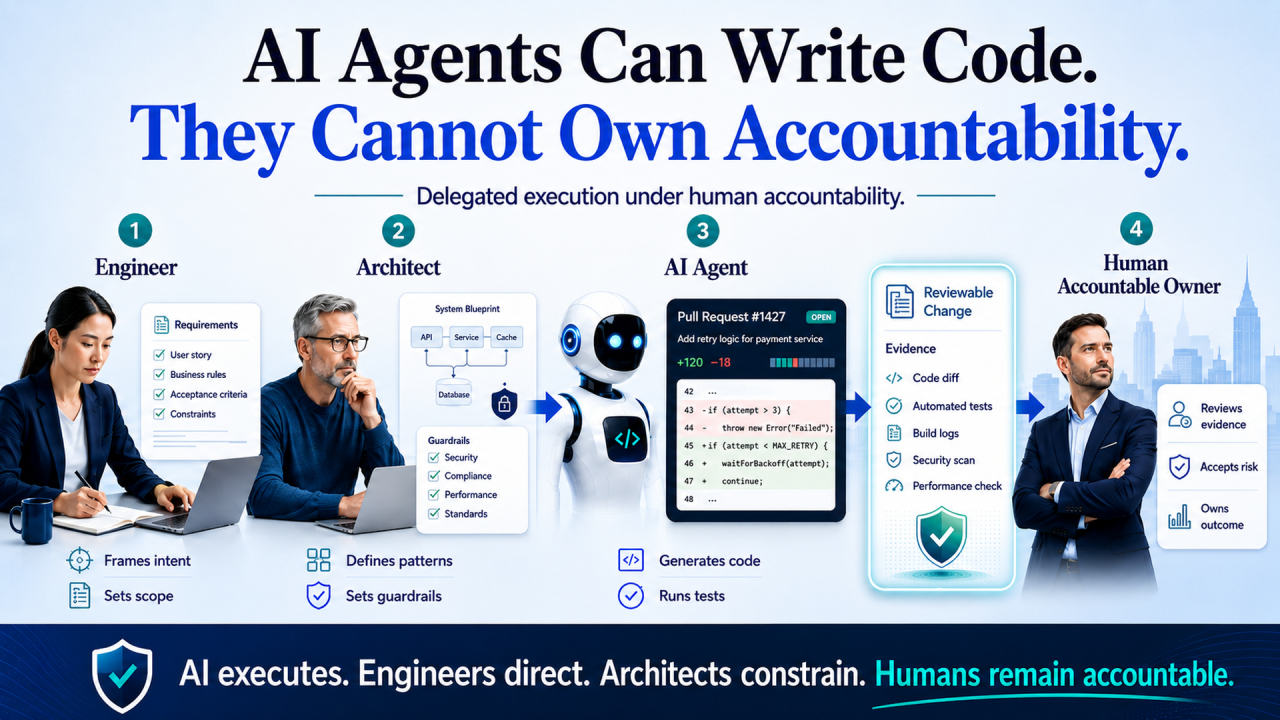
“AI agents execute delegated tasks under human accountability.”
Under an automation mindset, the goal is to remove humans from the loop.
Under a delegation mindset, the goal is to clarify where humans are needed, where agents can execute, what constraints they must operate within, and what evidence is required before work moves forward.
A better way to visualize the model is not as a handoff from human to machine, but as a governed loop: humans frame and constrain the work. The agent executes. Humans evaluate the evidence and accept accountability.
The Engineer Is Not Just a Reviewer
One mistake in the current conversation is reducing the human role to “reviewer.”
That is too narrow.
In an established enterprise environment, the engineer is not merely inspecting AI output at the end of the process. The engineer is shaping the work before the agent ever begins.
A requirement does not enter a preexisting codebase as a clean, isolated instruction.
It has to be translated.
The engineer helps translate:
“Build this capability”
into:
“Build this capability in this application, using these patterns, respecting these contracts, within these architectural boundaries, following these security expectations, aligning to these testing standards, and preserving these operational assumptions.”
That translation is engineering work.
It is also where many AI coding failures begin.
If the agent is pointed at the wrong problem, given the wrong scope, deprived of the right context, or unconstrained by the architecture, it will still produce code.
It may even produce a lot of code.
But that does not mean it produced the right change.
Architecture Becomes More Important, Not Less
A common assumption is that if AI writes more code, architecture matters less.
I think the opposite is true.
If AI agents can generate more code, faster, then architectural discipline becomes more important.
Architecture provides the boundaries that make delegated execution safe.
It tells the agent, and the humans directing it:
- Which patterns are acceptable.
- Which dependencies are allowed.
- Which integration points should be used.
- Which data handling rules matter.
- Which services own which responsibilities.
- Which failure modes must be considered.
- Which standards must be followed before code can move forward.
Without those constraints, AI-assisted delivery can become accelerated inconsistency.
More code. More variation. More hidden coupling. More rework. More risk.
AI does not eliminate engineering judgment.
AI raises the cost of weak engineering judgment.
Responsible Is Not Accountable
This is where RACI becomes useful.
In traditional delivery models, we distinguish between who is Responsible for doing the work and who is Accountable for the outcome.
AI agents fit naturally into the Responsible column.
They can be responsible for generating code, drafting tests, updating documentation, resolving lint errors, or preparing release notes.
They can also be responsible for parts of the approval workflow: summarizing diffs, mapping changes to requirements, running tests, checking policy, or identifying risk areas.
But accountability remains human.
A simple version looks like this:
For implementation work, the distinction is simple:
- AI can generate code, but the Engineer or Tech Lead owns the change.
- AI can create tests, but the Engineer or QA Lead owns the quality evidence.
- AI can summarize risk, but the human reviewer judges materiality.
- AI can recommend merge or no-merge, but it cannot approve the merge.
- AI can support release preparation, but it cannot accept release risk.
This is the core governance rule:
AI agents can be Responsible, but humans remain Accountable.
That rule sounds simple, but it has major implications for how enterprises should adopt coding agents.
Approval Is Not Authorship
In traditional engineering culture, accountability often meant deep personal ownership:
“I own this code. I understand how it works. If it breaks, I can fix it. If I made a bad decision, I own the consequences.”
That definition was tied to authorship, comprehension, and operational ownership.
With AI coding agents, that definition has to evolve.
Accountability cannot simply mean:
“I personally wrote every line.”
But it also cannot degrade into:
“I clicked approve.”
In an AI-assisted SDLC, accountability means a named human role accepts ownership for the correctness, risk, maintainability, and operational consequences of a change, based on sufficient understanding and evidence.
The accountable person may not have typed every line.
But they are still the person, or role, that decided the change was acceptable.
Approval becomes an evidence-based act of ownership.
The human approver is saying:
“I understand the intent, scope, risks, validation evidence, and operational impact well enough to accept accountability for this change.”
That evidence may include the original requirement, the scope given to the agent, the constraints used, the diff, the test results, the architecture impact, the known risks, and the evidence that acceptance criteria were met.
Many of those approval substeps can themselves be assisted or delegated to AI.
The agent can summarize. The agent can test. The agent can compare. The agent can flag risks. The agent can recommend.
But the agent cannot accept accountability.
AI can automate much of the approval workflow without becoming the approver.
The Work Shifts Rather Than Disappears
AI-generated implementation time should not be viewed as a simple subtraction from engineering effort.
An agent may generate code in minutes, but someone still has to frame the problem, provide context, define constraints, evaluate the output, and decide whether the change should move forward.
As execution becomes faster, more engineering effort shifts into the work around execution:
- Understanding the requirement.
- Translating intent into codebase-specific direction.
- Gathering the right context.
- Validating assumptions.
- Assessing architectural impact.
- Reviewing evidence.
- Deciding whether the change is safe to accept.
The bottleneck is no longer simply producing code.
It is determining whether the generated change is correct, appropriate, maintainable, and safe to accept into a production system.
That is why AI does not make engineering and architecture less important.
It makes weak engineering and architecture more expensive.
The New SDLC Question
The old question was:
Can AI write code?
The answer is increasingly yes.
But that is no longer the most important question.
The better enterprise question is:
Can we govern AI-generated change?
That means having clear answers to questions like:
- Who framed the work?
- Who translated the requirement into codebase-specific direction?
- What context was the agent given?
- What architectural constraints applied?
- What scope boundaries were set?
- What evidence was produced?
- Who approved the merge?
- Who accepted the release risk?
- Who owns the outcome if something goes wrong?
Those questions are not barriers to AI adoption.
They are what make AI adoption durable.
Closing Thought
AI agents will write more code.
They will execute more tasks. They will fix more builds. They will generate more tests. They will become a normal part of the software delivery lifecycle.
But the future of software engineering is not a world where nobody is accountable because an agent did the work.
The future is delegated execution under human accountability.
AI executes. Engineers direct. Architects constrain. Humans remain accountable.
And the organizations that understand that distinction will be the ones that get durable value from AI coding agents.
Not because they generate the most code.
Because they govern change the best.
Originally published on LinkedIn. View the original post.